

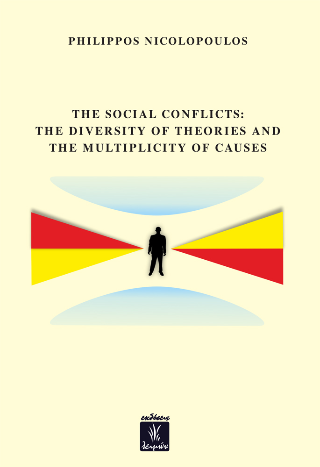
The social conflicts
The diversity of theories and the multiplicity of causes
ISBN: 978-618-5636-96-8
Κατάσταση Έκδοσης:
Κυκλοφορεί
Είδος:
Βιβλίο
Μορφή:
Χαρτόδετο
Αναγνωστικό Κοινό:
Ενήλικες - βιβλία προς το ευρύ κοινό
Θέμα:
Social conflicts, Αγγλικά, Ζώα και κοινωνία, Κοινωνία και κοινωνικές επιστήμες, Κοινωνικά και ηθικά ζητήματα, Κοινωνικές συγκρούσης, Κοινωνική σύγκρουση, Κοινωνιολογία
Γλώσσα:
Αγγλική
Έτος Έκδοσης:
2025
Εκδότης:
Παρασκευάκος Νικόλαος
Συγγραφέας:
Νικολόπουλος, Φίλιππος
Διαστάσεις:
14 x 21 εκ
Σελίδες:
78 σελ.
Τιμή Εκδότη: 12,72 €
Τιμή E-shop:
11,45 €
Περιγραφή
In last analysis the multiplicity of social conflict causes is corresponding to the many-faceted reality of human society. As we must face the society -especially the modern one- in complexity, with the same way we must conceive of the dynamics of conflict causes in their concrete interlinking and interaction. Every time the interlinking has its own historicity and its own reference to the macro-social level.
[...] A real sociological consideration tries to conceive of the total chain of interactions among groups, institutions, functions and processes in their diachronic perspective. So the empirical approach is combined with some theoretical guidelines referred to society as a whole.
[...] Instead of believing in a idyllic type of society without conflicts, it is wiser to study, understand and explain them scientifically in order to find ways for their confinement. If the creation of a conflictless society is a utopian plan, we can pursue more moderate goals. We can find ways to make the conflicts more civilized, to control them, to manage them and sometimes to resolve them for the benefit of the society. (A part of the Epilogue of the book)
[...] A real sociological consideration tries to conceive of the total chain of interactions among groups, institutions, functions and processes in their diachronic perspective. So the empirical approach is combined with some theoretical guidelines referred to society as a whole.
[...] Instead of believing in a idyllic type of society without conflicts, it is wiser to study, understand and explain them scientifically in order to find ways for their confinement. If the creation of a conflictless society is a utopian plan, we can pursue more moderate goals. We can find ways to make the conflicts more civilized, to control them, to manage them and sometimes to resolve them for the benefit of the society. (A part of the Epilogue of the book)
Σχετικά προϊόντα
-
Το Κοινωνικό Ζώο
Τιμή Εκδότη: 30,00 €
Τιμή E-shop: 27,00 € -
22 κείμενα ρήξης με την αστική ιδεολογία
Τιμή Εκδότη: 17,00 €
Τιμή E-shop: 15,30 € -
Μεσσηνία, Στατιστικά και Πολιτική
Τιμή Εκδότη: 58,43 €
Τιμή E-shop: 52,59 € -
Εισαγωγή στην Ανθρωπολογία
Τιμή Εκδότη: 63,22 €
Τιμή E-shop: 56,90 €